

While the Hills Are Still Alive

First published in the Huffington Post, May 16, 2013 

Sorry if I put this ear-tickling Rogers and Hammerstein song into your head today, but as you’re now stuck singing it all day, you might as well listen to the lyrics. The alpine mountains that go so well with the song’s swelling orchestrations are in retreat. In Glacier National Park in the United States, there were 150 glaciers at the turn of the 20th century. Now, there are only 26, and those are shrinking rapidly. The same is happening for Maria von Trapp’s beloved Austrian Alps. This was almost unimaginable a generation ago and would have sounded preposterous in 1959. Now, when we can well imagine, no — witness, the impacts of climate change, we still act as though our actions have no impact.

I spent a beautiful day in the Delaware Water Gap area last week. It’s amazing how close this breathtaking region is to NYC. But when I saw the sign above about polluted fish my delight was truly deflated. This park and sanctuary does not protect the nature within its boundaries. No national park classification prevents pollution from spoiling its air, land and sea.
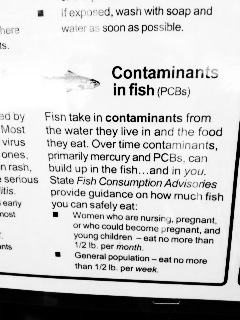
You can’t eat the fish in an area famous for great fishing spots and if this fish is not good for us to eat, imagine the experience for the fish themselves, as well as the effects this contamination has on the rest of the critters that need the fish for their diets, and the rest of the ecosystem of which the fish is a central part. In 1959, when The Sound of Music hit Broadway and three years before Rachel Carson published Silent Spring, it
No Nature, No Business: The Cost of Climate Change and the Financial Crisis

First published on CSRWire, April 15, 2013

No Nature, No Business is the underlying assumption that must guide all financial regulations and international climate treaty negotiations. I can imagine buy-in actually coming from a majority of both the world’s businesses and governments as a new level playing field is built.

I would never have imagined that my faith in corporations telling the truth would supersede my faith in governments telling the truth. But there is a change in the weather.

Our environment has become so consistently terrible that its effects on business are now undeniable, unpredictable and expensive. In multinational boardrooms and executive suites across the world, environmental problems are now noted as primary risk factors; derailing corporate success —even survival.

And corporations are beginning to step out and speak up.

Governments Fail To Connect Environmental Harm To Business Risks

Governments, not so much.

When extreme weather destroys 15 percent of the world’s cotton crop, corporations are hit with higher costs, shortages and unpredictable P&Ls. But governments do not yet connect the costs of climate change and pollution to the financial crises at hand – or the government’s bottom line.

Even though the external costs of coal and oil in the U.S. total more than $1.1 trillion (the 2012 investmentdeficit), these costs were not mentioned during the recent U.S. Congressional debate about the sequester. This “environmental debt” has not yet entered our governments’ financial deliberations.
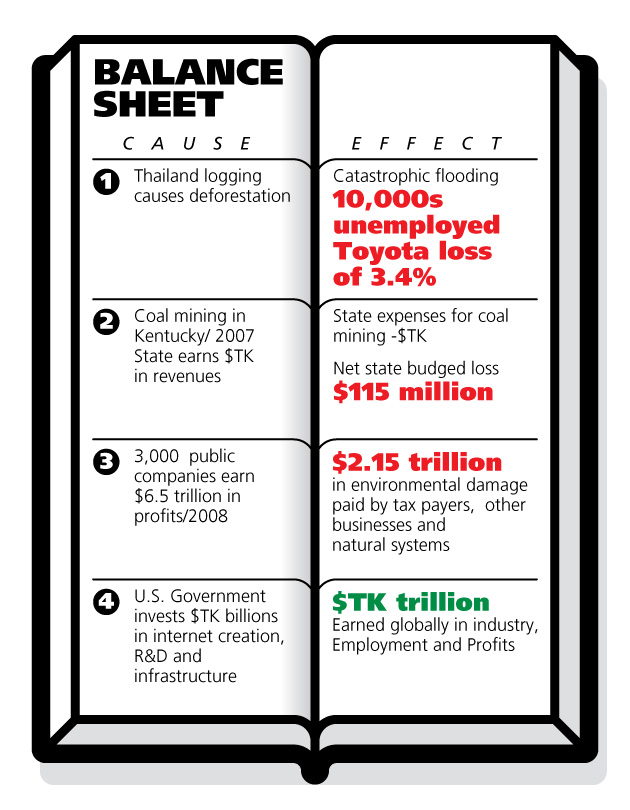
One exception: China recently noted that the cost of its environmental degradation comes to 3.5 percent of the country’s GDP. That’s a game-changing number and most certainly lower than the true cost.

Rewarding Smart Investments Now For Long Term Value

Responding with adequate urgency to the global environmental crisis

Countries and Companies Can Agree: Something’s Gotta Give

First published in the Huffington Post, April 9, 2013

China admits to having a big problem. This admission alone is big news. China’s own Ministry of Environmental Protection now estimates the costs of this degradation at $230 billion for 2010, or about 3.5 percent of its Gross Domestic Product. (This estimate came before Beijing’s recent air quality crisis and the 15,000 dead pigs found floating in Shanghai’s water supply.) As Americans, we are a large part of China’s professed problem — both the causes and the solutions. Much of this pollution is caused by China’s huge consumption of the coal-fired energy that keeps its factories running round the clock as well as the manufacturing process itself.

How much of China’s exports go to the United States? In 2011, China exported $400 billionof goods to the United States and imported $104 billion of our goods, giving China a $300 billion trade surplus and United States politicians and economists agita. In 2009, according to the WTO, 25 percent of China’s total exports went to the United States. How much of China’s pollution is created by American demand and consumption of cheap Chinese goods, from clothing to computers and everything else?

But herein lies the opportunity. Right now, we do not pay the real price of any of our goods because we are not paying for their environmental degradation. But the Chinese government is now debating how much to spend on remediation, how much to spend on changing factories and electrical plants to cleaner technologies, and how much to spend on new agricultural practices. Numbers in tens of billions of dollars are being tossed around as necessary expenditures for protecting the country from untenable losses of viable water, land and

Let’s Talk About Environmental Debt

First published in the Huffington Post, March 15, 2013

As the country begins to feel the consequences of the new federal budget cuts, we must realize that all money is not created equal. The sad state of affairs is that neither the Obama administration nor the Congress seems willing to actually tell the truth about our federal budget. Today, one of our biggest financial burdens is environmental debt. In the near future, it will become the centerpiece of our financial troubles.

In 2011, a Harvard study showed that in just the United States, the full costs of coal extraction and combustion on top of the coal companies’ costs were between $350 – 500 billion a year. These hundreds of billions of dollars, called externalities in economics, represent actual bills paid by local and federal government, fisheries, businesses, schools, and unwitting families and their healthcare providers. Despite conventional wisdom, coal is not a cheap energy. Its price is cheap only because it is subsidized by its own victims. Two similar studies estimate the externalities of oil in the United States at over $800 billion annually.

Add together the external costs of coal and oil, and it is well over $1.1 trillion, the annual 2012 United States deficit and the trigger for the sequester. Clearly, environmental debt is already a serious contributor to fiscal instability. And it is never even debated by Congress.

Would you rather federal, state and local governments spend our money on preventing extreme weather in the future or on recovering from extreme weather? This is not a rhetorical question. This is the real financial equation that has to enter all decisions on public budgets. The sequester’s across-the-board cuts treat all government expenditures with the same

Go to Top