
Power, Love and Money

First posted in the Guardian, December 6th, 2013

As an environmentalist, producer and businesswoman, I have always thought that moving anyone to action takes either power (or money) or love (or sex). Sometimes it takes all two (or four).

In a revelatory few weeks of theater, many of my assumptions about power and money were sent packing. I saw a biting and brilliant all-woman production of Julius Caesar, Shakespeare’s ultimate power play. And I also caught a hysterically funny production (not Book of Mormon funny but uproarious nonetheless) of the Twelfth Night, Shakespeare’s funniest romantic comedy.

Hmm, the women got inside the very male power struggles of the Roman Empire (set in a modern prison) and the men were clearly as bewitched, bothered and bewildered as the most foolish of archetypal maidens. This is a new world of cross-gender understanding, and a very welcome one.

Now if women can also get hold of the money part of the equation that runs the world, we’d really have some social evolution going on. Therein lies the rub. We women are gaining power in many ways, but still, in the realm of the real power and money tables (corporate boards, CEOs and senior management, cabinet ministers and entrepreneurs of high-impact businesses), we disrupt the economic order less than we could.

And the world certainly needs disruption, both to alleviate the great environmental burden we are placing on the planet and our children and also to remedy the terrible income inequality that threatens every nation’s social fabric.

Here are some depressing statistics. Women who work full-time currently earn 77 cents on the dollar in the United States, a statistic that has remained static for 10 years. This pay gap exists in nearly every occupation,

Courage and the modern business

First posted on the 2degreesNetwork on November 28th, 2013. 

The laws of nature and the rules of business are currently in direct collision. Today, the biggest polluter makes the biggest profit. Short-term earnings govern financial analysts’ worldview, and a company that spends smart dollars for a healthy return within five years — both in profits as well as savings in energy, waste and water — well, that just doesn’t cut it with Wall Street. Short-term earnings trump long-term value. Therein lies the rub.

To counter this, confoundingly complex integrated reporting and natural capital accounting efforts are being led by both the giants and upstarts of the financial service industry, myriad trade associations and civil society organizations as well as the World Bank. But some of this work has already reached the shore.

Puma was the first company to create an Environmental Profit & Loss Statement (EP&L) that measured and accounted for both its 2010 profits as well as the company’s toll on the environment. This statement showed that Puma’s environmental costs would have eaten 72% of its annual profit, €145 million. Adding to its astonishing transparency, Puma convened experts across the spectrum to review and improve its EP&L methodology. Although the EP&L, with the aid of both PricewaterhouseCoopers and TruCost, went four levels down the supply chain, this new accounting is an imperfect science.

But all accounting is imperfect. One day your coal assets look hardy on your books, and the next year they look like stranded assets. As I note in my book, Environmental Debt: The Hidden Costs of a Changing Global Economy, “Ratan Tata recently admitted that the energy from his company’s new massive coal power plant in India will bring energy to market at roughly the same price

Addicted to cars: why can’t New York City break its bad transit habit?

First published in The Guardian, October 7th, 2013

Photo: Several high-volume roadways cut through Central Park. Photograph: Murdo Macleod/Murdo Macleod

Last week, on my way to Newark Airport from Manhattan, I looked across the highway to view the traffic entering New York’s most densely populated borough. The dedicated bus lane was moving steadily and swiftly toward the Lincoln Tunnel. The rest of the inbound highway was a parking lot, mostly filled with cars occupied by one person each. It was 7.45am and these cars would spend the next hour – or more – driving the last five miles into Manhattan. Meanwhile, the buses would get there in 15 minutes max.

Why do these people drive? I dunno.

On buses, trains and ferries, passengers can read, text, talk on the phone, rest, sleep, write, do a puzzle, check email and do anything else that’s not inconsiderate toward their neighbors; they have far more options than when they’re driving. And most modes of public transportation are faster, cheaper and easier than driving and parking in Manhattan.

So it confounds me why people choose to drive when they could take public transportation.

But fuggedaboutem. Let’s talk about the rest of us. This folly doesn’t just affect the drivers, but also hurts everyone else.

When private cars enter Manhattan by the hundreds of thousands every day, they create air pollution that adds huge extra healthcare costs for the city. New studies actually show that air pollution costs more than tobacco. Drivers also create unsafe streets when they ignore crosswalks, traffic signals and cellphone restrictions. And they make ungodly noise, which, for me, is almost unbearable. I am certain that there are huge uncounted costs in cellular stress and overall anxiety caused by the sensory assault of

The Carbon Diaries

First published in the Huffington Post, October 8th, 2013

I just finished reading a fantastic novel, The Carbon Diaries, by Saci Lloyd (2010). It has tons of music and sex, so of course it’s riveting, but its main theme is climate change. It is the imagined diary of a 16-year-old London girl living through the carbon rationing following the Great Storm of 2015. The U.K. is the first to have this rationing as there is finally an understanding that a radical decrease in greenhouse gas emissions is URGENT. The rest of Europe and the world are watching intently as the U.K. goes through its paces and eventually moves to water rationing as well.

I was reading the book during the actual Great Floods of 2013 in Colorado and Mexico. In fact, had I read this book anytime during 2013, I would have had the backdrop of millennia-old glaciers spewing water from beneath their surfaces, droughts followed by floods followed by droughts, all at levels not seen in hundreds of years (or ever). These 2013 weather events will cost hundreds of billions of dollars now and in the future for public agencies, private businesses and individuals. This money increases our debt and limits our financial ability to protect national parks, natural resources, cultural treasures and education. And screws all of today’s kids.

The many cool 16-year-olds that I know are noticeably into two areas — music and farming. These city kids are embracing organic farming with a gusto and rigor that is inspiring. Oddly, many proclaim that their actions are more personal than political, though often as they come of age, politics creeps into the agenda. This new approach to governing and growing one’s own food

New Business Alternatives for Obama’s Climate Change Program

First published in the Huffington Post, September 9, 2013

President Obama’s emphatic stances on climate change during his inaugural address were indeed welcome words. Most analysts are focusing on the administration’s ability to use new regulatory powers, largely through the EPA. But there are two other options that are currently underused and under-imagined.

First, patent pooling has been used since the 19th century to spur innovation in industry to support either a wartime emergency or a financial debacle. I believe that climate change qualifies on both counts. And the Securities and Exchange Commission has new rules that require public corporations to disclose their climate change risk. These rules are new (2010) and currently vague, but have the potential to begin the incorporation of external costs as well as long-term impacts into corporate P&Ls and balance sheets.

Farmers, most businesses, victims of recent extreme weather events (drought, heat wave, fire, flood), and the taxpaying citizens forced to cover the costs of these weather events all understand viscerally that something’s gotta change. And quickly. President Obama appears to concur.

It is time to change intellectual property rules so that competitors can cooperate and also retain financial protection. When President Franklin Roosevelt took America into WWII, he set tremendously audacious goals for industry and also called for national sacrifice to support the military effort. Many Americans and car companies especially bristled at this. However in hindsight, it is clear that this wartime effort not only enabled the Allied defeat of fascism but laid the foundation for America’s post-war technological and industrial dominance. If current government policy (all governments, not just American) prioritized renewable energy as the U.S. government prioritized military manufacturing in 1941, the world would quickly see a revolution in renewable energy technologies.

What’s Going On. Business and History

Businesses' power to impact society extends beyond their carbon footprints and working conditions. What companies have fundamentally changed the world? Motown is not only a delight (of course, it's playing now to inspire me), but also showcases the power of business to change culture. And it's not alone. Other businesses also altered the zeitgeist and, in turn, history.

Seven lessons on sustainability from Star Trek

First published in The Guardian, August 28th 2013

Captain Jean-Luc Picard: You know, Geordi, I spent the better part of my life exploring space. I have charted new worlds, I’ve met dozens of new species. And I believe that these were all valuable ends in themselves. And now it seems that… all this while, I was… helping to damage the thing that I hold most dear.

Lt. Commander Geordi La Forge: It won’t turn out that way, Captain. We still have time to make it better.

– from Star Trek: The Next Generation, “Force of Nature” (1993)

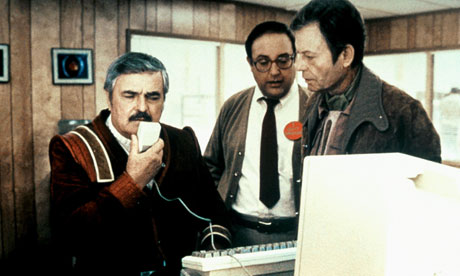
Spanning five decades and several generations, Star Trek has deeply influenced many of us. Each of its incarnations – six television series and 12 movies – opined about courage, humility, friendship, ambition, myriad social and political structures, problem solving and the environment.

The adherence to protection of every kind of species and habitat runs through all of Star Trek, and its principles give it great relevance to sustainability professionals of today. Here are some of Star Trek’s lessons for sustainability:

On biodiversity

Dr. Miranda Jones: I understand, Mr. Spock. The glory of creation is in its infinite diversity.

Mr. Spock: And the ways our differences combine, to create meaning and beauty.

– from Star Trek, “Is There in Truth No Beauty?” (1968)

Spock: To hunt a species to extinction is not logical.

Kirk: Ironic. When man was killing these creatures, he was destroying his own future.”

– from Star Trek IV: The Voyage Home (1986)

The Prime Directive, in essence, states: Don’t meddle in other planet’s peoples, history, culture or environment. This remains incredibly relevant to the world today. Our use of resources far and wide is wiping out species at an extraordinary rate (30% – 50% of all species may be

How West’s throwaway culture destroys basic freedoms in China

First published in The Guardian, August 23rd, 2013

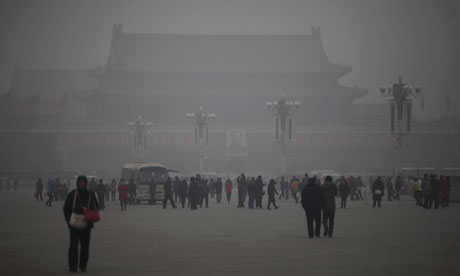
Photo: People walk on Tiananmen Square as heavy pollution lingers in the air. Photograph: Diego Azubel/EPA

I recently had the good fortune to meet a Chinese student, Wei Qing, who grew up in Luoyang, an ancient Chinese city famous as the capital city for thirteen dynasties.

Luoyang is nowhere near the largest pollution zones of China and Qing is proud of the culture she learned as a child and student. She’s a well-educated young woman, getting her masters degree in Environmental Education at an American university. She has the energy and enthusiasm of those ready to roll up their sleeves and do great work in the world.

As we enjoyed and admired the Nova Scotia skies together, Qing noted, “There are never blue skies in most of China.” I demurred, “Never?” She said, “Well, perhaps one or two days a year, but basically, the sky is never blue where I grew up.”

Again, I was taken aback as Qing explained that a blue sky was a great luxury for her. (I was only able to find anecdotal data to quantify the actual days of blue skies over Chinese cities.) The acceptance of the unacceptable remains: Qing does not expect to see what we count as a core part of our basic wellbeing.

The natural next step in my mind was to recognise that it is the production of our cheap goods that is the largest cause of this horrifying condition. We must urgently reconsider the true costs of our everyday behaviour.

It is one thing to read statistics such as 3.5% of China’s GDP is caused by environmental degradation, almost certainly a low estimate, or see pictures on the worst air pollution days in Beijing,

The new financial ledger

First published in The Guardian, July 10, 2013

We all know about the two sides of the financial ledger – profit and loss corresponding to cost and expense. But there is a basic piece of the financial picture that is not yet on the books – cause and effect. Every financial transaction affects the environment, and the environment is embedded in every financial transaction. Every transaction.

Our financial and environmental crises are inextricably connected – both in the causes and solutions. Much too often, one corporation’s actions and assets become liabilities for other parties – taxpayers, businesses, families and natural ecosystems. I call this “environmental debt”, and it is as risky for financial security as subprime mortgages wrapped in credit default swaps. These are the connections we do not yet account for properly.

For example, in 2011, floods in Thailand effectively shut down the country. These intense storms became catastrophic because of massive deforestation, much of which occurred in the 20th century. Without enough trees, the ground was unable to soak up the floodwater. Local Thai factories that produced car parts were closed for months. These closures caused shortages for Toyota and Honda, and both companies were forced to suspend manufacturing in Kentucky, Singapore and the Philippines. Toyota alone lost production of 260,000 vehicles (3.4% of its previous annual output) and tens of thousands of workers lost their jobs in several countries.

Logging in 20th century Thailand caused financial havoc around the world in 2011 – a good 20 years after much of it occurred. The people of Thailand, several governments, numerous companies and shareholders from around the world all paid the logging’s environmental debt.

The financial industry is beginning to debate 

Crisis Joe Woes: The Coffee Industry Promotes Excess and Waste

First published on CSRWire, June 7, 2013

I have a coffee jones.  I follow all things caffeinated and java-like and I am crestfallen and furious that the newest coffee trend is to use single-serve pods.

We now understand waste, water usage, manufacturing, mining, freight transport, and packaging and their effects on the world. It seems madness to develop a new product line that increases all of the above.

This new product line decidedly lowers a company’s CSR profile. And the companies with strong CSR profiles who develop these products? What are they thinking?

There is nothing positive about replacing a perfectly fine product with one that uses significantly more packaging, freight, waste, manufacturing, plastic, aluminum, and dyes. If individual fresh cups of coffee are desired, coffee in tea-bag-like devices would do the trick and would be fully compostable.

Life Cyle Costs

The companies and the customers who use these products should have to pay for their environmental impacts up front. These pods now represent seven percent of the coffee sold in the U.S. and 20 percent in Europe. The market is growing rapidly, and the pods are piling up in landfills. Some of them are supposedly recyclable, but to do so is time-consuming and messy.

In fact, these pods are rarely recovered. Even if they are recycled, their production and recycling still waste huge amounts of material, energy, and water.

So, let’s add up the environmental costs of this totally unnecessary aluminum mining, manufacturing, production, packaging and transport. Then, we’ll add the landfill cost of these pods and charge customers and companies on a pro rata basis for the packaging.

If we calculated the environmental cost of a cup of coffee in a French press, percolator or drip device vs. the environmental cost

Go to Top