
Forbes’ Inspiring Social Entrepreneur Ideas

This Forbes website list of inspiring social entrepreneur ideas highlights Amy’s proposal for accelerated depreciation for green infrastructure. See more of her thoughts on the issue here.

From the Forbes list:

#3. Corporations harm the environment but many don’t want to.  Amy Larkin, author of Environmental Debt: The Hidden Costs of a Changing Global Economy explained the connection between the growing environmental crisis and global economics. She noted that many corporations want to invest in clean tech, but choose not to because of the short term financial pain—even though many green investments have positive long term financial impacts. She advocated specifically for accelerated depreciation for green infrastructure investments to incentivize, really enable, corporations to invest in reducing the environmental harm.

Climate change survival: companies need courage… and new metrics

First published in the Guardian on April 24th, 2014. 

Today, tremendous work is being done to develop the metrics of natural capital. All kinds of very smart people and organizations are making the “business case” for sustainability, making tortuous calculations as they analyze the life cycles, carbon production and water footprints of a variety of products, all in an attempt to make the best possible business and marketing choices.

This arduous work is being done – finally – by gifted and smart accountants, economists and supply chain and manufacturing experts, from the Global Reporting Initiative to the Sustainability Accounting Standards Board to the Carbon Disclosure Project to the World Bank’sNatural Capital Accounting. I appreciate all of this work. We need it.

But, impressive as this work is, it is no replacement for having the courage to actually contemplate the state of the world around us. Right now, we are looking on with a mix of disbelief and ennui as extreme weather engulfs us. In some cases, we are trying to take what appear to be reasonable steps, mostly in order to protect our precarious perch in the world’s economy. The trouble is, the time for reasonable has passed. We have somehow forgotten that if there is no nature, there is no business.

We are in a global environmental emergency, but we are behaving as if incremental improvements to “business as usual” will do. Talk to a scientist, a fisherman, a native of a low-lying island or a farmer stymied by drought, heat or floods. Or for that matter, talk to anyone who has been flooded in southern England or Pakistan; or who is making flood

A simple accounting change can make green infrastructure more attractive

First published in the Guardian, April 8th 2014

Many businesses struggle with the question of how to invest in large fixed assets. These are painstaking decisions, because they always demand long-term thinking and guessing about markets, future technologies and risk factors. How much revenue will a new factory generate? How much savings will a new technology produce? What unintended consequences might occur because of a purchase?

As companies attempt to answer these questions, they also have to deal with long-term trends that further complicate the question of fixed-asset purchases. Issues as diverse as globalization, environmental degradation and climate change can affect commodity prices, cause fires or floods, drive up the cost of living, and undermine political stability and security. And even positive developments, like the growing use of renewable energy, can lead to instability as coal producing areas will need new economic lifeblood. For governments hoping to deal with these trends by incentivizing green investment, one simple accounting change – accelerated depreciation for green infrastructure – could make a considerable difference.

Companies attempting to adjust to these changes with large fixed assets often find themselves trying to balance a financially viable long-term solution with a steep up-front cost. At the same time, companies also have to deal with several long-term issues that further complicate their purchasing decisions. I recounted one such story in my book,Environmental Debt: the Hidden Costs of a Changing Global Economy. Several years ago, PepsiCo built a state-of-the-art facility for its Frito-Lay division in Arizona. The installation had near net-zero waste, water, and energy systems. It isn’t hard to see how these advanced systems not only helped PepsiCo, but also the surrounding community: approaching net-zero water use would seem pretty valuable, actually imperative,

Feelings, not facts: negotiating for a new business paradigm

First published in the Huffington Post, March 6th, 2014 

When I first started working with corporations on transformative green technologies, I would discuss my excitement to other environmentalists, and they would retort: “But they’re only doing that because they’re greedy… not because it’s the right thing.” I would reply, “Who are we, the morality police? They’re taking a great leap forward.” Very few businesspeople and politicians are primarily motivated by a grand vision of a better world. Some certainly are, and we need more of them — but they are often fired or dismissed as the office nag, lunatic or nuisance. It takes a huge amount of courage to be a whistleblower or to suggest something out of the box. Keeping a company profitable is daunting enough. The lyrics from Frank Loesser’s Broadway show, How to Succeed in Business Without Really Trying says it all… the song is called “The Company Way.”

Finch: When they want brilliant thinking, from employees
Twimble: That is no concern of mine.
Finch: Suppose a man of genius,makes suggestions?
Twimble: Watch that genius get suggested to resign.
Finch: So you play it the company way?
Twimble: All company policy is by me OK.
Finch: You’ll never rise up to the top.
Twimble: But there’s one thing clear: Whoever the company fires,I will still be here.

Ain’t that the truth? But the company way ain’t gonna take us where we gotta go. Only emotional intelligence and peer pressure will help us breach the delta between today’s business as usual and a radical rethink of sourcing, operations, profits and products. While accountants and consultancies are planning the future of financial reporting, it is time for the rest of us to pave the road for true profits. That road is less

On steroids and quarterly reports: short-term fixes can screw up the system

First published in the Guardian, February 17th, 2014

Something – maybe a bat, although nobody was certain – recently bit my good friend Arnie. What happened next is an allegory for how short-term fixes can really screw up a system, whether it’s an ecosystem or an immune system or, while we’re at it, a financial system.

Erring on the side of caution, Arnie (not his real name) got the rabies vaccine, which consists of five shots. Shot number one went fine. But after shot number two, he immediately started feeling sick – his symptoms resembled the flu, but with some weird neurological symptoms – and he ended up in the emergency room.

A Benadryl drip seemed to relieve him somewhat, and he went home, still feeling pretty bad and non-functional, but not feeling like he would crumple into a ball on the floor. Then Arnie got the third shot, and got even sicker. I wanted to know why Arnie was so sick … scary sick. So I took to the internet and learned about adverse responses to rabies shots, how rare they are and, also, how serious they can be – kind of like a black swan event for business.

Twelve days after the initial shot, Arnie asked me to meet him at the emergency room because he thought he would pass out. He could barely move or keep his eyes open. At the hospital ER, the doctors seemed perplexed and checked for the “emergent” problems. Did he need to be intubated, coded, operated on? None of the above.

The doctors hydrated him and offered more Benadryl. Then they brought him steroids, which they explained would make him feel much better. I intervened directly – in fact, I stepped

Human error: how business can learn from past mistakes

First published in the Guardian on February 7th, 2014

There are at least two areas where I agree with most major religions. First, we must treat one another with compassion and kindness – the golden rule of do unto others as you would have them do unto you applies. Second, humans are inherently imperfect. We make terrible mistakes and we are capable of incredible negligence and cruelty in addition to our numerous finer qualities such as valor, graciousness and creativity.

Somehow, in our use of technology and chemicals, we presume that this second maxim of imperfection and moral failings doesn’t hold. That’s why we think it’s OK to have tens of thousands of nuclear weapons globally despite the launch codes being in the hands of the imperfect humans who have manufactured them. No surprise, then, that 92 US air force officers who hold these codes are in the middle of a scandal involving cheating and drug use. Errors could obviously be catastrophic – blackmail and impaired judgment do not mix well with nuclear capabilities.

We continue to deploy technology with the running assumption that humans won’t make mistakes or behave badly. That is genuinely stupid; history continues to show us so on every continent and in every culture. These kinds of disasters are not black swan events: they should be anticipated if we just presume that humans will err. As Mark Twain noted, “Everyone is a moon, and has a dark side which he never shows to anybody.”

With this in mind, one of the most important guidelines for 21st century business, where technological prowess is unbelievable, is theprecautionary principle. First adopted by the United Nations in 1982 as part of the World Charter for Nature, the precautionary

The sharks and the bees: what nature’s patterns teach us about sourcing

First posted in the Guardian, January 22, 2014

“Although human subtlety makes a variety of inventions by different means to the same end, it will never devise an invention more beautiful, more simple, or more direct than does nature, because in her inventions nothing is lacking, and nothing is superfluous.”

– Leonardo da Vinci

When sharks, honeybees and other animals forage for food, they move in a pattern of short movements in one area combined with a few longer treks to more distant areas. This pattern is called Lévy walks (or flights).

National Academy of Sciences study released last month, “Evidence of Lévy walk foraging patterns in human hunter–gatherers”, also found that the Hadza, hunter-gatherers from northern Tanzania, perform Lévy walks when foraging for a wide variety of food items.

The authors suggest that this type of movement profile is a “fundamental feature of human landscape use, regardless of the physical or cultural environment, and may have played an important role in the evolution of human mobility”.

We can see the same kind of pattern closer to home: in Saturday Night Fever and HBO’s Girls, young people seek their mates in their local Brooklyn neighborhoods, with an occasional jaunt to Manhattan. And in Law & Order: Criminal Intent, brilliant detective Robert Goren often solves the crime by identifying the movement patterns of serial murderers.

Nature, our subconscious master, is very, very powerful. Nature’s intricate web is the genius embedded in every breath we take and every morsel we eat. It’s incumbent upon us to start looking more closely at its patterns and constraints.

Many scientists and investors are already doing this. Janine Benyus, who named the emerging discipline of biomimicry, describes “seeking sustainable solutions by emulating nature’s designs and processes (for instance, solar

Mutually Assured Survival

By Amy Larkin and Siddhartha Velandy

This post was originally published on the Huffington Post on January 10th, 2014 and co-authored by Siddhartha Velandy, a Major in United States Marine Corps Reserve and author of The Green Arms Race: Reorienting the Discussion on Climate Change, Energy Policy, and National Security, 3 HARV. NAT’L SEC. J. 309 (2012). The views expressed here are his own.

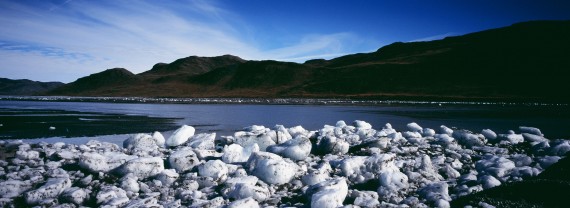
It’s official. Climate change has opened a new frontier. Defense Secretary Chuck Hagel recently announced the Pentagon’s first ever “Arctic Strategy,” which is designed to protect American security interests as rising global temperatures melt polar ice. He noted that climate change is “transforming what was a frozen desert into an evolving navigable ocean.” This increased access will heighten tensions in the region as nations compete for newly-accessible natural resources and trade routes.

We are creatures from different ends of our nation’s cultural spectrum — one from the military and one from Greenpeace. Even so, we share a vision for the United States in order to safeguard our environment and best provide for the future security of the nation. We call it Mutually Assured Survival, and we are encouraged that Secretary Hagel asserts his intention to address the long term in his short-term Pentagon decision-making. But he did not mention the most important piece of a long-term strategy — the R&D funding necessary to eliminate American dependence on oil — not just fossil fuels from foreign sources. This will prevent the need to engage in conflict in the Arctic (and elsewhere) as well as help prevent runaway climate chaos.

Responding to this threat requires decisive action and consistent funding. Melting ice caps and the corresponding rise in sea levels will increase global

Embrace the bad stuff: turning crisis into opportunity

First published in the Guardian, December 19, 2013.

My years of work as a radical environmentalist in concert with multinational business has inspired me to believe that we can change our mindset from “Why don’t they?” to “Why don’t we?” So many engineers and executives demonstrate courage, tenacity and creativity when faced with regulation or resource constraint in the pipeline.

Real opportunities for transformative change lie in preparing for crises. The National Academy of Science’s new report, Abrupt Impacts of Climate Change, states:

“To willfully ignore the threat of abrupt change could lead to more costs, loss of life, suffering, and environmental degradation … The time is here to be serious about the threat of tipping points so as to better anticipate and prepare ourselves for the inevitable surprises.”

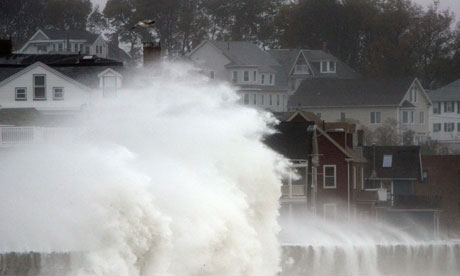
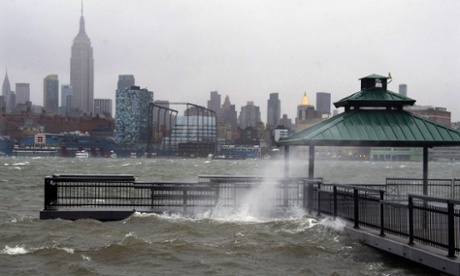
Before Hurricane Sandy hit the US’s north-east in 2012, scientists and meteorologists warned of a likely devastating weather event on the eastern seaboard at some point. By day one after the storm, it was clear that we would spend more than $100bn on recovery. You didn’t need an expert to imagine the financial devastation. But you did need serious analyses and one helluva backbone to make smart, tough decisions on infrastructure, relocation and rebuilding.

So taxpayers (federal, regional and local), businesses and families spent this huge sum of money, and we will likely have to spend it all over again in the near future. These difficult expenditures were almost obligatory despite strong leadership from local governors and mayors. We were simply not prepared for this predictable event. We do not have our transition agenda in place.

We are already between a rock and a hard place and we have no Plan B. We must now have

Go to Top